
- I N T E R V E N T I O N P H I L O S O P H Y -

The Private Practice Difference
-
Always 1:1 full hour sessions with a doctoral level clinician
-
Never delegated to an assistant
-
90 minute sessions encouraged for trauma survivors and sensitized nervous systems
-
Internal assessments never required
-
Always paced to the need for safety and control
-
Therapeutic environment prioritized – no sterile medical office feel
-
Healing Informed Care – not just trauma informed.
Carl Jung viewed Alchemy as a symbolic map of psychological development – the process of integrating the shadow, healing inner splits, and uniting unconscious and conscious parts of the self. Inner Alchemy is the art of transforming your inner world – turning emotional wounds into wisdom, stress into clarity, and raw life experience into embodied power. This is the ethos of Modern Alchemy, where the body and brain learn to speak to one another again.
Clinical Prioritization:
How physical function meets mental health.
Emphasis on modulation of the efferent and afferent pathways through balanced top-down and bottom-up pathway focus.

via...
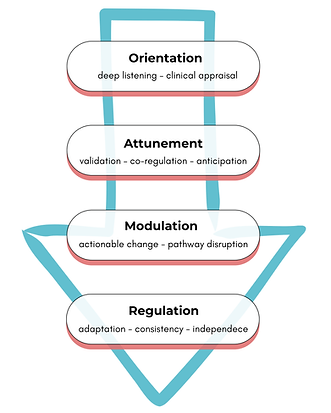
Explore the 2026 Doctoral Capstone Project outcomes of Abigale Hardison, OTD student, in collaboration with Dr. Heather Truog, OTD, OTR/L at Modern Alchemy in how this implementation looks in a group based model.
Details for Providers...
How physical function meets mental health.
As a doctor of occupational therapy, my practice is rooted and centered in the clinical models and frameworks that guide this profession. All internveitons are filtered through the lens of OT.
Specifically, I draw heavily upon:
-
Model of Human Occupation: Seeking to determine what the patterns of motivation, habituation, and performance are shaped by in the inner and external variables of the lived experience.
-
Person-Environment-Occupation-Performance Model: Similar to how social workers seek to understand how the individual and their contextual environment intertwine to impact engagement and functional participation in the lived experience, the occupational therapist deepens this by understand the depth of necessity related to the task of 'doing' -- that which occupies our time.
-
Sensory Processing and Regulation: Perhaps the most important layer of this OT focused work, it is the unique ability of the OT clinical expert to understand and relate all nervous system functions back to the afferent (sensory) and efferent (motor) pathway interactions.
-
Neuromuscular Re-education: Retraining of the efferent (motor) pathway from the brain to body -- always seeking to optimize the coordination, sequencing, and rhythm of the entire three-dimensional canister (never just the pelvic floor musculature). Then deepening this into a head-to-toe understanding of the sequencing of the kinematic chain, and the capacity for the deep core to be given priority prior to retraining of dynamic movement sequence...
-
Biomechanical/Musculoskeletal: Once neuromuscular rhythm has been established, sequencing of movement with emphasis on stability and alignment is initiated. Often integrated with Medical Therapeutic Yoga and Pelvic Pro (CES) internvetion protocols.
-
Cognitive Behavioral Therapy: Because it's never simply about the tissues, function is always linked to the internal variables of motivation, regulation and intellectualization. This is where true change happens -- understanding, problem solving, and habit reforming.
Integrated frameworks:
Attachment Theory
Developmental Trauma Theory
Polyvagal Theory
Somatic Embodiment
Jungian Depth Psychology
Internal Family Systems
Mindfulness Based Self Compassion
Acceptance and Commitment Therapy